

This year, Nepal's Madhesh Province, also known as the "Granary" of the country, faced a prolonged drought during the rice planting season. In July 2025, the monsoon did not come, which stopped the agricultural cycle. The transplanting rates of rice have fallen by half compared to last year. This setback could mean a loss of as much as 450,000 metric tons of the staple grain nationwide, damaging the economy and food security in a nation where more than half of the population depends on agriculture, which makes up nearly a quarter of the Gross Domestic Product (GDP).
The effect is visible in fields that should be waterlogged but are dry and cracked. Farmers are under intense emotional and financial pressure, with many facing possible crop failure and financial ruin. This is not just an agricultural matter; it is the silent crisis of the nation’s lifeline economic sector. Now the ripple effects of this agricultural drought are being felt as part of an even deeper socio-economic crisis, affecting people’s everyday existence. People in various villages in the Terai are reeling under an acute drinking water crisis, with the water levels of wells drying up and hand pumps not being able to provide water.
The shortage is forcing farmers to adopt expensive and unsustainable practices just to keep even small plots of ground alive. Most of them now travel with tankers laden with water and incur costs of over Rs 1,000 per trip or expensive diesel-run pumps. The despair has had tragic consequences, including deaths from electrocution as farmers tried to run electric pumps for emergency irrigation. This reminds us that the crisis is more than just an agricultural one—it threatens our most fundamental human needs and creates a breeding ground for social and health issues that demand rapid and robust solutions.
This disaster is more than a weather event; it is a collapse of ecological and infrastructure systems caused by the intersection of multiple interwoven factors. The immediate concern is the lack of rain, exacerbated by global climate change that is steadily pushing up the maximum temperatures in Nepal. This results in erratic rainfall schedule and the frustrating paradox of drought and flood within the same area. This “Too Much Too Little” water crisis is an indication of a dysfunctional water management system in this region. Under normal circumstances, the land soaks in the monsoon rain, replenishing its reserves of groundwater during the dry season. But environmental damage has caused heavy rains to run quickly off and erode the soil instead of recharging underground water, and has created a cycle of water scarcity and plenty. The root cause of this water crisis is the depletion of the Chure hills, a natural water bank for the plains. These soft-rock, forested slopes are critical as a sponge for absorbing rain and refilling underground aquifers. Yet this ecosystem has been compromised by harmful human activities, notably unrestrained construction sand and gravel extraction. Unplanned development has disrupted natural drainage systems in addition to growing human settlements and deforestation which have resulted in the drying up of rivers and springs and a decline in groundwater levels. This environmental problem is a governance one and deprivation its backlash, since the damage is done when there are strong business political ties. Critics say that by ascribing the crisis only to climate change, they allow government officials to absolve themselves of blame for failing to regulate those industries, without which the problem becomes a question of governance that remains unsolved and can’t stop the forest from falling in the only age in which it can truly be restored.
On top of these environmental problems, significant institutional and infrastructure failures persist. The government’s response to water scarcity has been mostly reactive, often resulting in drilling more borewells as an immediate fix. This is not an effective solution for large-scale agricultural needs and worsens the long-term water crisis. Additionally, there has been widespread neglect of existing surface irrigation systems. Canals, such as the Bagmati and Gandak networks, are often underused or in poor condition. This policy failure has forced farmers to forsake these more reliable water sources for expensive and unsustainable groundwater pumping, further jeopardizing food security and ecological balance.
In order to minimize suffering, it is best to adopt a dual approach that embarks with emergency measures that would span for a long term. Currently, emergency measures consist of water deliveries, digging new wells that cater to life-saving drinking water but does not address irrigation, and might worsen the crisis in the long term. A better response must include the fast provision of agricultural relief packs like distributing Sukkha Dhan rice seed, a drought tolerant seed that withstands weeks of aridity, and other supportive local varieties.
There is also the need of a strategic shift to growing alternative low water needing crops. Traditional crops with a short growing time such as Foxtail Millet and Amaranth, a nutrient dense pseudo cereal, can replace the water guzzling rice. To help the farmers take the plunge, these agricultural aids ought to include financial relief, subsidized inputs, and work-for-food famine relief programs to form a safety net. While paying attention to long term shifts is critical to lasting improvement, addressing the immediate concern is of equal importance.
The first step for the long term strategic solution is the ecological restoration of the Chure hills. Without large-scale reforestation and strict regulation of mining activities on restoration of the hills’ rain absorption capability, no other water management activities will succeed. This also involves changing the strategy of attempting to seal off groundwater sinks losing water to over-extraction, to retaining surface water, which is cheaper. This can be done by building small-scale community level structures such as small ponds and check dams to capture monsoon runoff which is highly cost-effective. At the household level, fulcrum-style rainwater harvesting systems can be deployed to relieve the burden on the groundwater system. Alongside ecological restoration, which is of paramount importance, other elements such as energy and irrigation infrastructure and farming approaches also appraised and equipped with the applicable technologies of the time. The most efficient and cost-effective approach is retaining the older structures and completing them with advanced systems as needed.
Prioritization such as in the Rani Jamara Kulariya Irrigation Project which is reported to have increased crop yields by 40% and enhanced the resilience of the community, should be given to repairing and modernizing irrigation canals. Resilient policies regulating the use of enforced groundwater to be controlled and managed, to support project activities, are justified in applying centralized data management approaches, such as simple sensors to control the system in real-time. We should also encourage innovations in agriculture to improve water saving technologies, such as the spaced network of waterways, use System of Rice Intensification (SRI) methods of cultivation whereby the yields of rice are attained using water-saving methods. Advanced and empowered farmers with the right tools in precision agriculture such as soil moisture downs sensors will enable them to manage irrigation and crop improve healthier outputs.
Ultimately, the success of any technical solution relies on strong governance and an engaged community. For instance, Nepal’s Community Forest Management program which almost doubled the country’s forest cover is another example of the success of local action. The same “up to and including the grassroots” approach should apply to water management by empowering trained and supported Water User Associations to self-manage irrigation systems.
The government’s approach to water use is still very reactive and crisis-based, and so all evidence-based strategies to shift this must be adopted. The strategies range from setting appropriate prices to conserve water to creating fair and equitable water distribution systems. Enhanced bundling of credit and technical assistance for water-saving technologies will empower farmers to take advantage of the critical innovations. In closing, Nepal’s agricultural resilience will not be achieved without addressing deep, far-reaching and complex issues. Most of the time, the first response should be emergency relief.
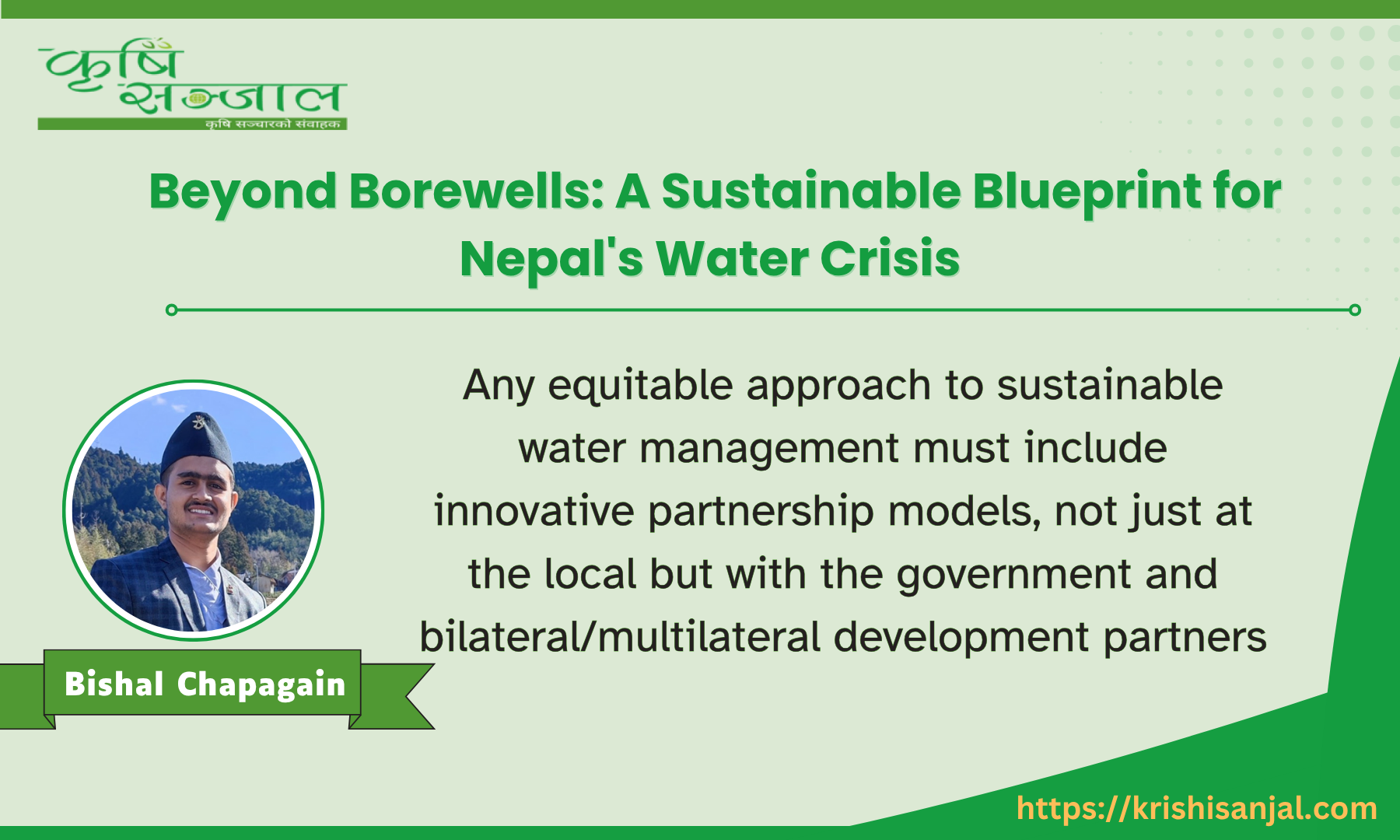
This relief should provide the framework for solid, enduring water management investments. For instance, to foundational and stabilization investments, the Chure hills must be restored and protected. Any equitable approach to sustainable water management must include innovative partnership models, not just at the local but with the government and bilateral/multilateral development partners. The economic benefits of this shift are clear; community-driven investments are not only environmentally and socially beneficial but also financially wise, yielding higher returns than repetitive emergency spending. By adopting this proactive and integrated method, Nepal can transition from constant crises to lasting agricultural, economic, and social resilience.
Bishal Chapagain, Undergraduate student, Agriculture and Forestry University, Rampur, Chitwan